
The traditional offering made on behalf of your family, arranged in the form that suits your visit.
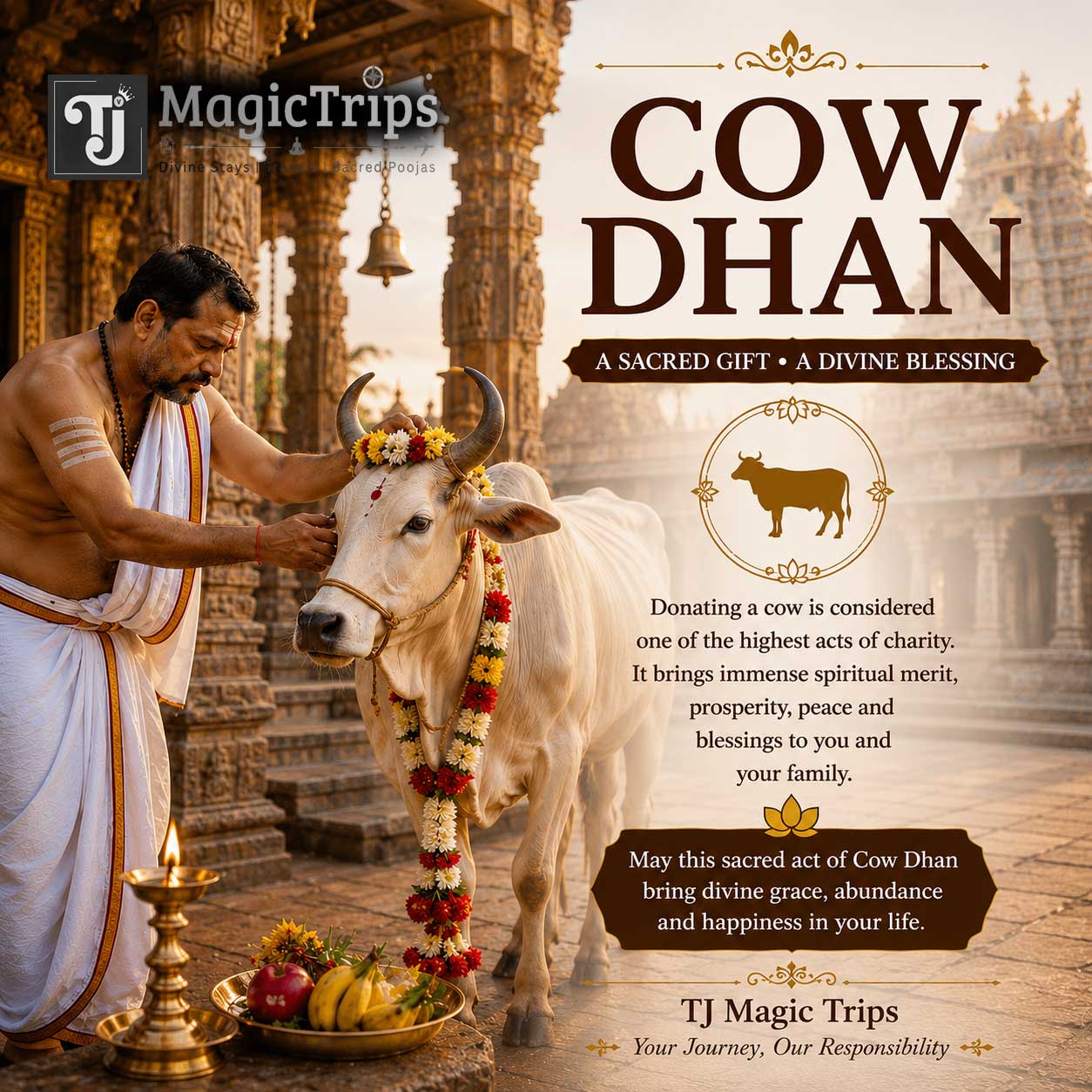
Gau Daan - also written godaan, and called Cow Dhan in common use - is among the oldest forms of daan in Hindu practice. It is made both as an observance in its own right and as part of a wider set of rites, and families frequently arrange it on behalf of a departed relative alongside ancestral observances.
In practice, pilgrims observe it in one of two forms. Which one suits you depends on your time and what your family intends.
This is the form most visiting families observe. The priest leads the scriptural sankalpam in which the value of a cow is pledged on your behalf, naming your family and the purpose of the offering. The offering itself goes towards the upkeep of cows - their feed, fodder and care.
It is completed in a single sitting and can be arranged alongside whatever other rites you are performing during the visit.
Gau Grasa is the simpler observance, suited to families with limited time. You are given green grass or bananas to feed a cow near the Agni Theertham shore or the temple entrance, and a token amount is given to the caretaker. This satisfies the requirement of Gau Seva - the service of a cow.
Many families performing ancestral rites observe Gau Grasa on the same morning, before or after the main ritual.
Gau Daan is frequently arranged together with Thila Homam, Pinda Pradanam or the yearly thithi as part of a single visit. Tell us which rites your family intends to observe and we will plan the visit around them.
| Also known as | Gau Daan, godaan, Cow Dhan; Gau Seva for the symbolic form |
|---|---|
| Forms commonly observed | The monetary sankalpam, or Gau Grasa - feeding a cow |
| Performed by | Experienced Vedic priests arranged by TJ Magic Trips |
| Where Gau Grasa is done | Near the Agni Theertham shore or the temple entrance |
| Commonly arranged with | Thila Homam, Pinda Pradanam, or the yearly thithi |
| Cost | Quoted on enquiry - call or send the form and we will confirm |
| Booking | Please contact us before you travel so the priest can be arranged |
Tell us which form you would like and which other rites your family intends to observe, and we will arrange the priest and plan the visit around them. If you are unsure which form suits your situation, mention it when you enquire and we can talk it through.
Send us your preferred date and we will call you to confirm the arrangements.
Or call +91 99881 10803
No. Most visiting families observe Gau Daan in the monetary form, where the value of a cow is pledged through the sankalpam, or as Gau Grasa, where a cow is fed near the temple. Both are long-established forms of the observance.
Gau Daan is the offering made through the sankalpam, in which the value of a cow is pledged. Gau Grasa is the act of feeding a cow, satisfying the requirement of Gau Seva. Families with limited time often observe Gau Grasa.
Near the Agni Theertham shore or by the temple entrance, where cows are kept by caretakers. A token amount is given to the caretaker.
Yes. Families commonly observe it alongside Thila Homam, Pinda Pradanam or the yearly thithi during the same visit.
Cost depends on the arrangements you need. Call us or send the enquiry form and we will confirm before you travel.